Genetics and History: How to Explore the Past Together (Public Lecture)

IIAS, Feldman Bldg, Givat Ram, JLM
11/12/2025
17:30

The dynamic development of Archaeogenetics has created spectacular new opportunities to learn more about historical periods. This poses a challenge for the Humanities, to open up to the potential of new scientific and bioinformatic methods; and for Genetics, to collaborate with historians and archaeologists in order to get the most out of their data. Translating genetic models into historical narratives requires adopting historical method, not simply relating genetic results to main-stream historical knowledge. Interdisciplinary collaboration should include devising the questions, selecting the material, interpreting the results and drawing historical conclusions.

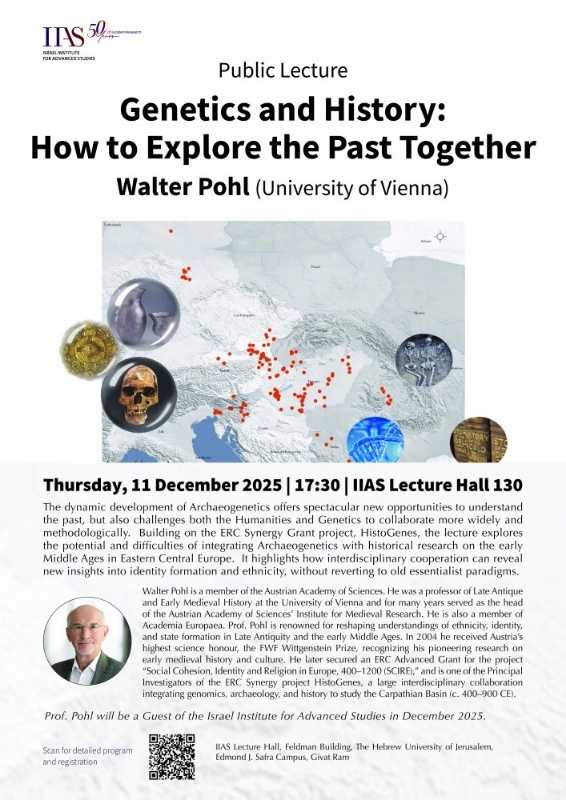
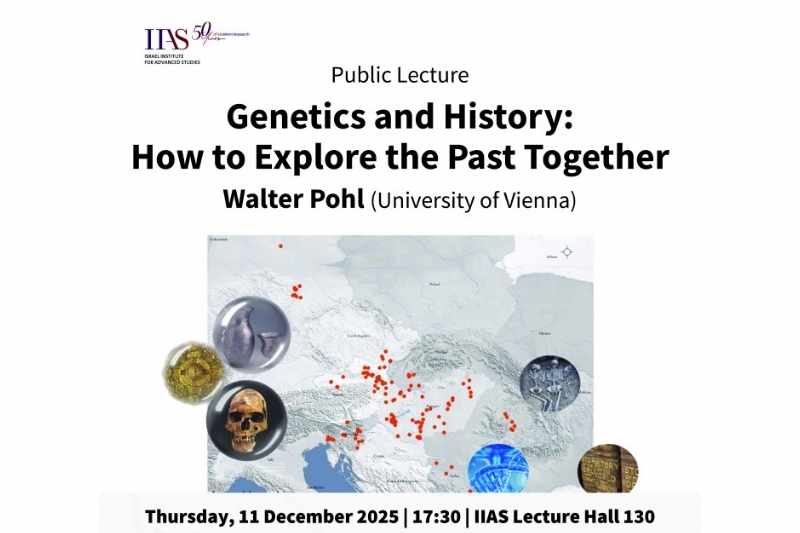
The lecture builds on the experience of the ERC Synergy Grant project HistoGenes, coordinated at the Austrian Academy of Sciences. It deals with the population history of the early Middle Ages (c. 400-900) in Eastern Central Europe. The lecture will address the potential and the problems of a cooperation between Archaeogenetics and the historical disciplines. In particular, it will discuss the extent to which interdisciplinary collaboration can give us new insights into identity formation and the role of ethnicity in past societies, without falling back onto old essentialist paradigms. It will also sketch some of the results about the population history of the period and their significance for further research.
 

SHARE:

Members:

Research Group:

Event Details:

Event Start Date:

December 11, 2025
17:30

Event End Date:

Location Event:

IIAS, Feldman Bldg, Givat Ram, JLM

For inquiries, please leave your details

Genetics and History: How to Explore the Past Together (Public Lecture)

Event Start Date

December 11, 2025
17:30

Event End Date

December 11, 2025

Location Event

IIAS, Feldman Bldg, Givat Ram, JLM

Add to Calendar

[add_to_calendar]

The dynamic development of Archaeogenetics has created spectacular new opportunities to learn more about historical periods. This poses a challenge for the Humanities, to open up to the potential of new scientific and bioinformatic methods; and for Genetics, to collaborate with historians and archaeologists in order to get the most out of their data. Translating genetic models into historical narratives requires adopting historical method, not simply relating genetic results to main-stream historical knowledge. Interdisciplinary collaboration should include devising the questions, selecting the material, interpreting the results and drawing historical conclusions.

The lecture builds on the experience of the ERC Synergy Grant project HistoGenes, coordinated at the Austrian Academy of Sciences. It deals with the population history of the early Middle Ages (c. 400-900) in Eastern Central Europe. The lecture will address the potential and the problems of a cooperation between Archaeogenetics and the historical disciplines. In particular, it will discuss the extent to which interdisciplinary collaboration can give us new insights into identity formation and the role of ethnicity in past societies, without falling back onto old essentialist paradigms. It will also sketch some of the results about the population history of the period and their significance for further research.


No data was found

SHARE:

Members

For inquiries, please leave your details

Apply here:

Genetics and History: How to Explore the Past Together (Public Lecture)

Dec 11, 2025

17:30

IIAS, Feldman Bldg, Givat Ram, JLM

[add_to_calendar]

The dynamic development of Archaeogenetics has created spectacular new opportunities to learn more about historical periods. This poses a challenge for the Humanities, to open up to the potential of new scientific and bioinformatic methods; and for Genetics, to collaborate with historians and archaeologists in order to get the most out of their data. Translating genetic models into historical narratives requires adopting historical method, not simply relating genetic results to main-stream historical knowledge. Interdisciplinary collaboration should include devising the questions, selecting the material, interpreting the results and drawing historical conclusions.

The lecture builds on the experience of the ERC Synergy Grant project HistoGenes, coordinated at the Austrian Academy of Sciences. It deals with the population history of the early Middle Ages (c. 400-900) in Eastern Central Europe. The lecture will address the potential and the problems of a cooperation between Archaeogenetics and the historical disciplines. In particular, it will discuss the extent to which interdisciplinary collaboration can give us new insights into identity formation and the role of ethnicity in past societies, without falling back onto old essentialist paradigms. It will also sketch some of the results about the population history of the period and their significance for further research.


No data was found

SHARE:

Dec 11, 2025

17:30

IIAS, Feldman Bldg, Givat Ram, JLM

[add_to_calendar]

The dynamic development of Archaeogenetics has created spectacular new opportunities to learn more about historical periods. This poses a challenge for the Humanities, to open up to the potential of new scientific and bioinformatic methods; and for Genetics, to collaborate with historians and archaeologists in order to get the most out of their data. Translating genetic models into historical narratives requires adopting historical method, not simply relating genetic results to main-stream historical knowledge. Interdisciplinary collaboration should include devising the questions, selecting the material, interpreting the results and drawing historical conclusions.

The lecture builds on the experience of the ERC Synergy Grant project HistoGenes, coordinated at the Austrian Academy of Sciences. It deals with the population history of the early Middle Ages (c. 400-900) in Eastern Central Europe. The lecture will address the potential and the problems of a cooperation between Archaeogenetics and the historical disciplines. In particular, it will discuss the extent to which interdisciplinary collaboration can give us new insights into identity formation and the role of ethnicity in past societies, without falling back onto old essentialist paradigms. It will also sketch some of the results about the population history of the period and their significance for further research.


SHARE:

Members

Apply here:

Relation Research Group