Two Lectures on Voting Theory
1. Elections and Strategic Voting: Majority Rule (16:00-17:30 GMT +3)
2. Elections and Preference Intensity: Borda’s Rule (17:45-19:15 GMT +3)
Which voting method a society uses to elect its public officials (e.g., first-past-the-post or runoff voting) will greatly affect that society’s politics. The Jerusalem Summer School in Economics plans to devote a summer to Voting in the next few years. In the meantime, the School’s director, Eric Maskin, will give two 90-minute lectures on voting theory on June 25. The first will argue that majority rule (Condorcet’s method) is the best method to use when strategic voting is a major concern. The second will argue that Arrow’s independence of irrelevant alternatives condition is unjustifiably strong but, when relaxed appropriately, leads not to an impossibility result but to a unique social welfare function: the Borda count, a method capable of reflecting voters’ preference intensities. As is traditional in summer schools, audience members will be encouraged to ask questions.
Two Lectures on Voting Theory
1. Elections and Strategic Voting: Majority Rule (16:00-17:30 GMT +3)
2. Elections and Preference Intensity: Borda’s Rule (17:45-19:15 GMT +3)
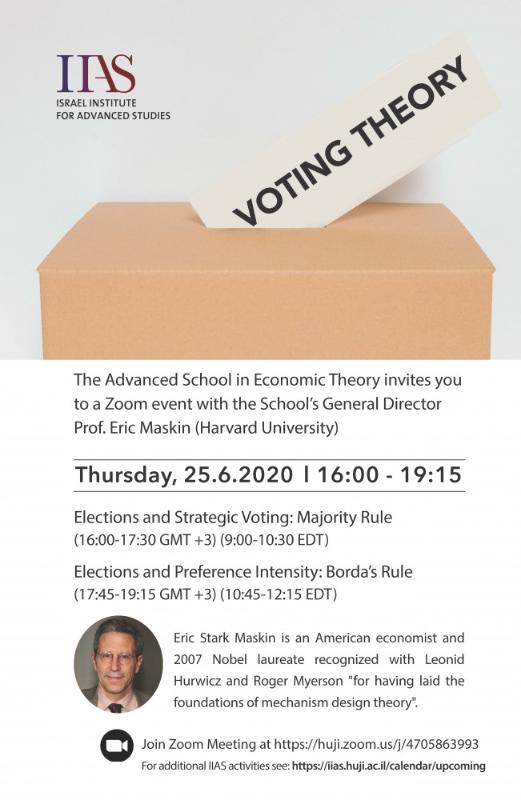
Which voting method a society uses to elect its public officials (e.g., first-past-the-post or runoff voting) will greatly affect that society’s politics. The Jerusalem Summer School in Economics plans to devote a summer to Voting in the next few years. In the meantime, the School’s director, Eric Maskin, will give two 90-minute lectures on voting theory on June 25. The first will argue that majority rule (Condorcet’s method) is the best method to use when strategic voting is a major concern. The second will argue that Arrow’s independence of irrelevant alternatives condition is unjustifiably strong but, when relaxed appropriately, leads not to an impossibility result but to a unique social welfare function: the Borda count, a method capable of reflecting voters’ preference intensities. As is traditional in summer schools, audience members will be encouraged to ask questions.

Two Lectures on Voting Theory
1. Elections and Strategic Voting: Majority Rule (16:00-17:30 GMT +3)
2. Elections and Preference Intensity: Borda’s Rule (17:45-19:15 GMT +3)
Which voting method a society uses to elect its public officials (e.g., first-past-the-post or runoff voting) will greatly affect that society’s politics. The Jerusalem Summer School in Economics plans to devote a summer to Voting in the next few years. In the meantime, the School’s director, Eric Maskin, will give two 90-minute lectures on voting theory on June 25. The first will argue that majority rule (Condorcet’s method) is the best method to use when strategic voting is a major concern. The second will argue that Arrow’s independence of irrelevant alternatives condition is unjustifiably strong but, when relaxed appropriately, leads not to an impossibility result but to a unique social welfare function: the Borda count, a method capable of reflecting voters’ preference intensities. As is traditional in summer schools, audience members will be encouraged to ask questions.

Two Lectures on Voting Theory
1. Elections and Strategic Voting: Majority Rule (16:00-17:30 GMT +3)
2. Elections and Preference Intensity: Borda’s Rule (17:45-19:15 GMT +3)
Which voting method a society uses to elect its public officials (e.g., first-past-the-post or runoff voting) will greatly affect that society’s politics. The Jerusalem Summer School in Economics plans to devote a summer to Voting in the next few years. In the meantime, the School’s director, Eric Maskin, will give two 90-minute lectures on voting theory on June 25. The first will argue that majority rule (Condorcet’s method) is the best method to use when strategic voting is a major concern. The second will argue that Arrow’s independence of irrelevant alternatives condition is unjustifiably strong but, when relaxed appropriately, leads not to an impossibility result but to a unique social welfare function: the Borda count, a method capable of reflecting voters’ preference intensities. As is traditional in summer schools, audience members will be encouraged to ask questions.
